Responsible Innovation Letters (06): GTC DC and When Tech Outpaces Institutions
Hi all,
I wanted to share some of my thoughts with you after attending Nvidia’s GPU Technology Conference in Washington, DC.
Don't Stop Thinking About Tomorrow
Last week I had flashbacks to 1993. I'll share the significance of that year in a bit.
But let's go back in time. Whitney Houston's "I Will Always Love You" was everywhere. (You might be humming it right now.) Bill Clinton's campaign anthem, "Don't Stop Thinking About Tomorrow," defined the moment. Newt Gingrich was House Minority Whip. Most of us were still logging onto the internet with dial-up modems (you can hear the sound right now). The idea of a search engine didn't exist yet.
Fast forward to 2025. I was in Washington, DC at Nvidia's GPU Technology Conference. Jensen Huang, Nvidia's co-founder and CEO, is an American success story. What he and his employees have built should be celebrated as part of America's contributions to discovery and technological progress.
Jensen's keynote reminded me about 1993. That was the year Nvidia was founded in Santa Clara. The company started out making chips for better video game graphics. The notion that this company would become central to the global AI economy? Not on anyone's roadmap.
Jensen walked through how Nvidia got here: 30+ years of patient infrastructure building. Not just chips, but CUDA (the programming model that makes GPUs accessible), partnerships, standards, the entire stack. Methodical construction, not magic.
He also painted a vision for the next 30 years: 6G wireless, quantum computing working alongside classical computers, AI factories, digital biology, autonomous manufacturing. It was as futuristic as it was compelling.
Will it all come true? Unclear. But we would have been hard-pressed in 1993 to predict where we are today.
That unpredictability is precisely why we need robust startup ecosystems, not just incumbents. Different games, different timelines, different breakthroughs. The next Nvidia is probably working on something that sounds niche right now.
Tech Outpaces Institutions
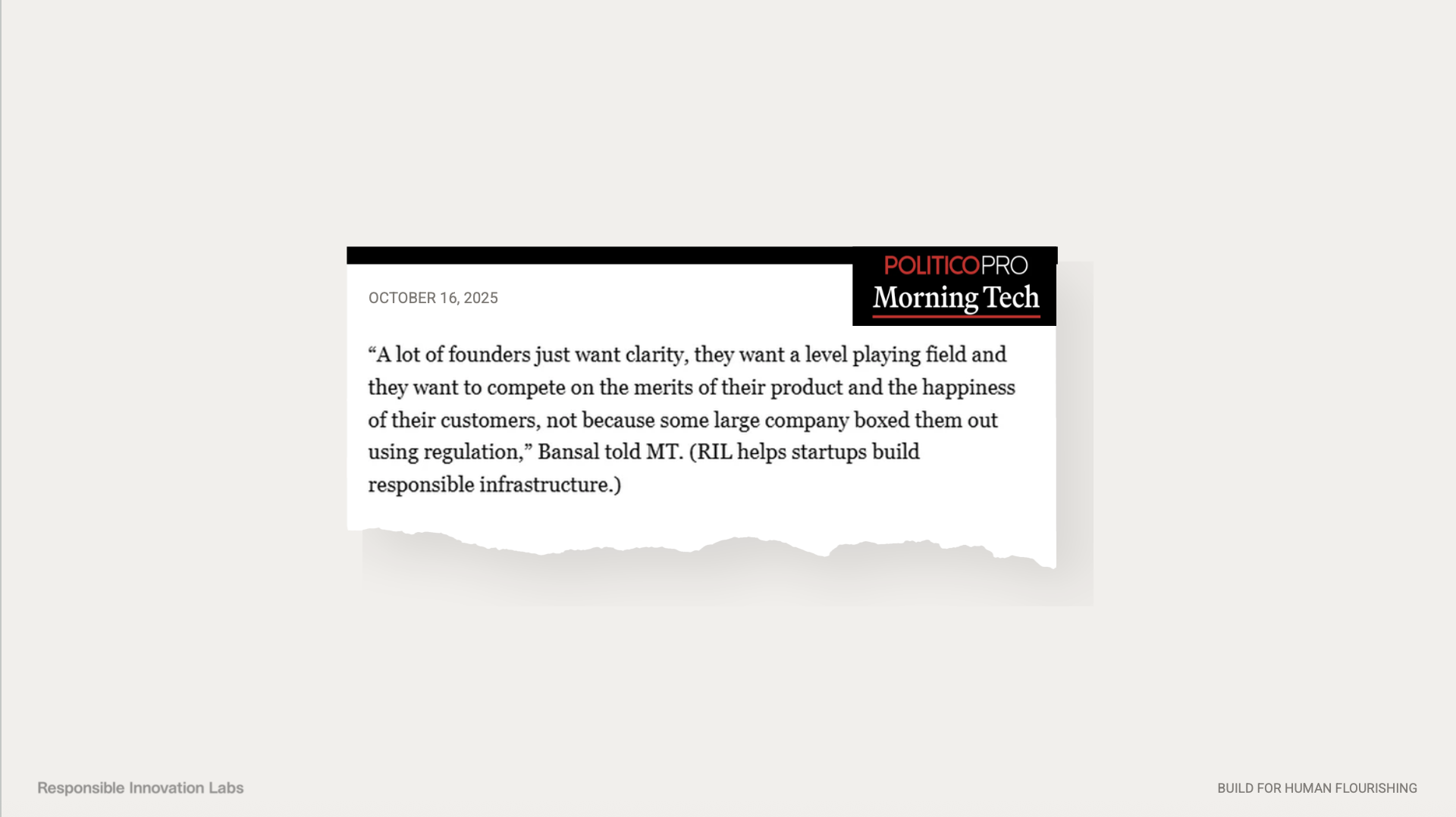
But are we ready for this pace? What about the policy ecosystem? I told Politico recently that our current federal policymakers in both parties, with a few notable exceptions, are adding to the uncertainty, not creating the conditions for responsible innovation and deployment.
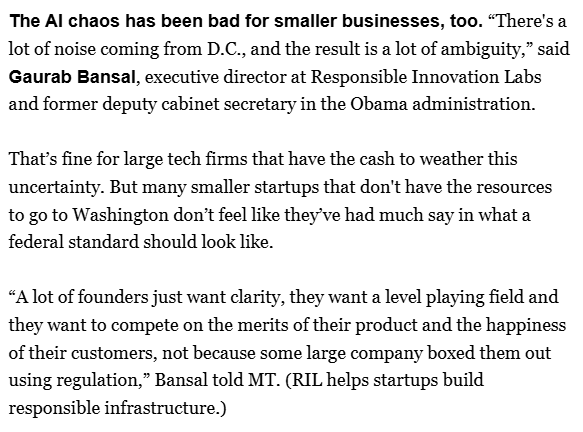
That ambiguity might be an asset for Nvidia with its endless resources. For the next Nvidia out there, chaos in the policy world slows down startups trying to compete.
Washington needs to do better. Much better. We cannot let policymakers off the hook for creating clarity and coherent frameworks that enable innovation while protecting the public interest.
But here's the reality: whether policy is chaotic or deregulatory, startups can't afford to wait for perfect conditions from Washington. This is where responsible innovation becomes essential. Not as a response to regulation, but as table stakes, like quality in manufacturing. You build it in from the start because it's how you achieve 30-year velocity.
Administrations change. Policy frameworks shift. But technological innovation keeps accelerating, often leaving our institutions scrambling to catch up. Just as our social norms and cultural expectations evolve, so too must the way we build companies and build new compacts between them and the public. This mismatch creates both risk and opportunity. The question is whether we choose to shape that future or simply react to it.
Even in today’s climate described as deregulatory, more and more startups are choosing to build differently than earlier tech generations. They understand that trust, reputation, and robust systems are competitive advantages, not compliance burdens. They're building the credibility infrastructure that lets them move quickly when commercial opportunities emerge.
New Era, New Building Modes
That's why Responsible Innovation Labs exists. We're building infrastructure so startup founders can move with intentionality from the start, creating space for those unexpected innovations to develop, and betting on the long game.
More dispatches to come as new technology and founders emerge from Silicon Valley and beyond.
Building something? Backing founders? Working on the technology transformation ahead? Let's talk about AI, workforce, startups, and responsible innovation.
Gaurab
View the article here.
Additional Resources and Tools
Get started on the things you can control: